- Jaguar has launched a cheaper version of the Jaguar XF 2.2-litre diesel, which was until now only available in the Luxury trim. This new Jaguar XF Executive Edition has been priced at Rs 45.12 lakh (ex-showroom, Mumbai). It, however, misses out on some features that the Luxury trim gets.
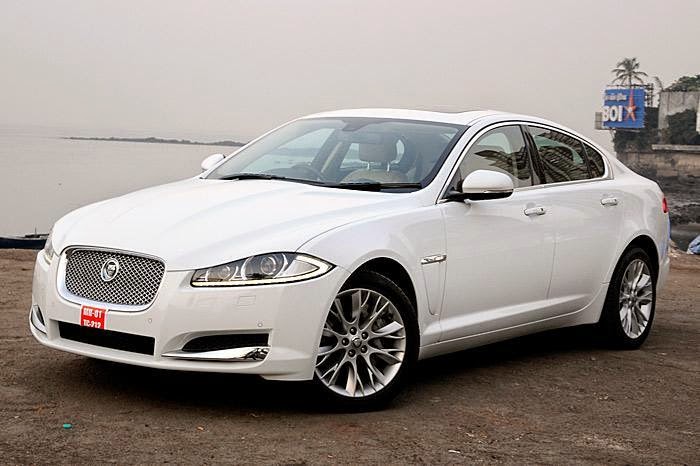
- In comparison to the standard Jaguar XF, the Executive Edition does not get memory function for the driver seat and mirrors; it gets rear parking sensors but no rearview camera; and no Front Passenger Seat Away button.
- The Front Passenger Seat Away button comfortably lets the driver or the passenger in the backseat adjust the front seat for better legroom.The Jaguar XF Executive Edition also misses out on a sunroof and a TV tuner.
- In place of leather seats, it gets fabric seats, and the interior mood lighting here has been kept simple.The new Jaguar XF Executive Edition will continue to draw power from a 2.2-litre diesel engine, mated to an eight speed automatic gearbox, which is the same motor that the higher trim gets.
- A year after the passing away of Italian design house Pininfarina’s figurehead, Sergio Pininfarina in 2012, the company built a concept as a tribute to him. After getting a 2013 Geneva unveil and a positive response from the public, it was decided that six models of the Ferrari Sergio will be made in collaboration with Ferrari. Each of the six cars will be made according to specifications given by their owner in a series of sessions at Ferrari's workshop in Maranello, while the final assembly will be done at the Pininfarina plant in Italy.

- Ferrari has now revealed the first of the six examples of the ‘Ferrari Sergio’ in Abu Dhabi. The Ferrari Sergio is based around the Ferrari 458 Spider, and features the latest iteration of the company's 597bhp 4.5-litre V8 engine, which also powers the Ferrari 458 Speciale. With this engine, the Sergio will be capable of achieving 0-100kph in 3.0sec.
- As for the design of the Ferrari Sergio, the core structure of the 458 Spider has been retained. It also uses all of the interior components of the car, although the cockpit has been reworked to include black leather upholstery with red stitching, a carbon dashboard, door well trims and Alacantara leather seat inserts. The wheelbase and the track remain unchanged. However, the Sergio’s bodyshell has been claimed to be stiffer than the 458 Spider’s, and it is about 100kg lighter too.

- Fabio Filippini, Pininfarina's chief designer said, "We asked Ferrari before even drawing the car, if we could do it and Luca di Montezemolo said we had all of his support. We decided it should be a mid-engined Ferrari because the first Sergio Ferrari was the Dino Berlinetta Speciale, the ancestor of all mid-engined Ferraris."
- Luca di Montezemolo recently stepped down from his post of chairman at Ferrari.
- The pricing of the Ferrari Sergio has not been revealed, however it is estimated to be around 2.5 million pounds (approx Rs 24 crore).
- Following the recent debut of the new X5 M and X6 M at the LA motor show, BMW has put the two performance SUV through some "Individual" customisations. The BMW X5 M Individual and X6 M Individual get a couple of visual and equipment upgrades over the standard models.

- Both cars get special paintjobs. The X5 Individual gets a Pyrite Brown metallic paint, which has Xirallic pigments that make certain areas appear like a darker hue than the others, while the X6 Individual gets Azurite Black metallic paint with shades of blue in it. On the inside, both the X5 M Individual and X6 M Individual benefit from white Merino leather upholstery & a matching white Alcantara leather headliner. They also get some piano black inserts and a leather-wrapped dashboard with contrast stitching.
- Power to the two models comes from the same engine as the standard models. The 4.4-litre V8 twin turbo engine makes 564bhp and 76.5kgm of torque, mated to an 8-speed automatic transmission.
- BMW will not sell these models in India.
- The healthy consumer response to the automated manual transmission variant of the Maruti Celerio shows that India is ready for clutch-free driving. While the market may not be ready for the more expensive pure automatics, traffic congestion in cities, with stop-and-start driving, is paving the way for automatic transmission vehicles here. Technologies that give users an automatic-like driving experience are set to gain ground.

- Among the technologies that could hold sway is Bosch’s eClutch. Unlike a fully automatic transmission, the eClutch automates the clutch only, not the transmission. The cable-less clutch pedal transmits an electric signal to an actuator, which decouples the clutch. In congested traffic conditions, this allows the driver in a manual transmission car to use first gear without using the clutch.
- Apart from the cost factor, the eClutch promises savings in fuel and lower emissions. Bosch claims that in start-stop coasting mode, the fuel consumption can come down by 10 percent. In India though, Bosch will initially offer idle coasting. “Europe is doing it (eClutch) with a big-bang approach. For them, carbon dioxide reduction is the main factor. We will create the subsystem where we pick what is necessary, enter and then slowly make our way up the value chain,” says Sandeep N, regional president India, Gasoline Systems, Bosch India. The eClutch may well be introduced here in 2016.

- Bosch also plans some inorganic moves in growing its two-wheeler business through new- age technologies. One motorbike that caught this correspondent’s eye at the Bosch facility is a ‘connected bike’. On the outside, it looks like any bike. However, it is the software inside that makes it interesting. Bosch engineers have developed a software development kit platform which offers developers to come up with a variety of mobile applications (apps). The connection with the bike is established through Bluetooth.
- The above project is being conducted on a KTM Duke, a premium bike. Bosch is also developing some technologies for the mass bike market. One product is the stop-start feature. Along with it, Bosch’s low cost EMS and a low-cost ABS for two-wheelers in India and India-like markets will play key roles in realising the German supplier’s plans of being a major player in the two-wheeler industry too.
